“With them God wrote the world”
Narcissus and Goldmund“With them God wrote the world” names Goldmund’s vision of letters as more than fixed marks: a written shape can change, evoke living nature, and become an act of artistic perception. Spoken to Narcissus, the phrase crystallizes the difference between Goldmund’s imaginative responsiveness and the mind’s demand for stable definitions.
Letters as Living Forms
Goldmund says that a flower petal or a tiny worm on a path can contain more than all the books in a library, because letters and words cannot fully encompass what they signify. His example begins with the Greek letters theta and omega. A slight tilt of the pen gives one a tail and turns it into a fish; the image opens onto streams and rivers, cool and humid water, Homer’s sea, and the waters on which Saint Peter walked. The other letter becomes a bird, shakes out its feathers, and flies away. The written sign does not remain a static symbol: through the maker’s hand and eye, it becomes a route into the abundance of the world.
The phrase “With them God wrote the world” concludes this movement from letter to creature to landscape. Goldmund imagines the alphabet as a means by which creation itself was inscribed, while his own pen can make a letter’s outline disclose images beyond its conventional use. The claim gives artistic seeing a generative force: a small alteration of form releases a world of associations.
Goldmund and Narcissus
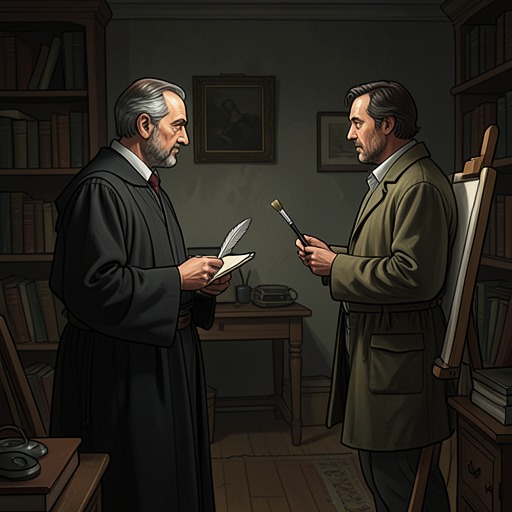
Goldmund offers this account as a glimpse of the dream world he rarely discusses with Narcissus. Narcissus answers that he does appreciate the magic of such letters, but distinguishes their imaginative power from their usefulness in science. Science requires definite, solid shapes and reliable symbols; it is concerned with what is actual rather than what might become possible. An omega cannot be permitted to change into a serpent or a bird when the mind depends on stable categories.
Their exchange makes the phrase more than a celebration of writing. It marks the difference between two ways of knowing: Goldmund’s openness to transformation and Narcissus’s intellectual discipline, which defines itself in opposition to nature. Narcissus does not dismiss the magic; he locates it outside scientific inquiry. Goldmund, for his part, has already begun to accept that he will not become a scholar. The exchange therefore gives a compact form to the divergence between his artistic vocation and the scholarly life associated with Narcissus.
A Principle of Artistic Perception
The image of the mutable Greek letter anticipates Goldmund’s practice as an artist: he attends to forms not as inert objects but as possibilities that can be perceived and shaped. Later, after returning to the cloister, he prepares to work by finding an empty shed beside the courtyard gate and equipping it as a workshop. He orders a drawing board and tools to his own precise plans, selects timber, and works with the blacksmith to make the knives, chisels, drills, and planes his carving requires. This material labor gives a practical counterpart to his earlier vision of the pen: an instrument’s smallest movement can alter a form, while a crafted object can carry the artist’s encounter with the visible world.
The sentence thus connects perception to making. Goldmund’s claim is not that words can explain everything, but that form can become alive when imagination recognizes what it might contain. In his account, artistic knowledge begins where fixed names cease to be sufficient; the letter becomes a fish or bird, and the sign opens onto nature without exhausting it.